Archive for ‘April, 2014’

By The Lenspeed Team

Spindle grille

What we have here is a CT200 Hybrid in F Sport trim. Sounds like an oxymoron statement? We think so too. But it seems like Lexus will not hold back on plans to beef up all models of their range with a sportier image, starting off with the soon-to-be trademark front face, or “Spindle Grille” in Lexus speak.

According to Lexus, they are adding more sporty visuals to an elegant design. Is this a matter of too many chefs spoiling the broth? We think so. We are huge fans of the tame, understated front fascia of the 2nd-gen Lexus IS and 3rd-gen GS (and certain Shers will agree with us). They are elegant, yet not overly sporty to a point of appearing too ostentatious. It’s the subtlety that drew us to the brand, rather than the current emphasis on a more energetic visual presence.

Well, it seems like they are now treading this path. But they might very possibly enter BMW’s territory. BMW has aced this balance of sporty dynamics with a stylish design for decades. As far as Lexus is concerned, it could spell danger for a brand with drivetrains and powertrains known to be smooth as silk. Yes, this sporty  “Spindle Grille” will amplify the character of their F Sport models, but from a business perspective, only time will tell if this gamble will pay off. Let’s wait and see.

Leave a comment

By James Wong

DSC_0134

The European summer is almost upon us. It’s April in 2014, but in countless occasions over the last few months I have been dreaming again and again about Lenspeed’s awesome Alpine tour. Did it really happen? Was I really at the Nürburgring, then up at the Alps, before finishing school and entering the corporate world proper? It is all fuzzy now, especially since the transition from university life to work has been sudden and paralysing, the latter at least in terms of the lack of free time. But one thing is for sure: I did not do my journey justice. It was more than 3,000 miles of driving, across 7 countries, all in the search of the thrill of driving. However, apart from a few Facebook posts, the story of the humble blue Clio 200 Cup across Europe wasn’t shared. That would be fine if not for my fading memory, which motivated me to pen this all down before they disappear into the whirlpool of an ageing mind. So, ladies and gents, fasten your seat-belts, get snug into the Recaros, and join us as we hop on the Eurotunnel for the continent… (time reverses to June 2013)

Pre-trip background: The dates were set for the road trip. We’ve got the car, we’ve got the people. Now, where do we go? Thanks to the helpful chaps at Pistonheads.com and the ever-reliable Google Maps (not so sure about the new one though…), we plotted our way from London to arrive at the Ring, but not before settling on Grindelwald as our base from which to explore the Alpine routes. It all came together somehow.

DSC_0951

Arriving on the mainland, we quickly sped across the dull Belgian landscape, passing Netherlands for a brief moment before entering Germany. En-route, we chanced upon an unexpected delight: vineyards. As we’ll be staying in wine country for the night, we drove through vineyard routes for the rest of the day for the heck of it and captured this shot in what seemed to be in the middle of the estate, with nary a care or concern. Confession: we stole no grapes.

DSC_1002

Our next stop was at a chalet town which can genuinely pass off as a set in a perfect Hollywood neighbourhood. Every house is identical, brand new and to be honest, a little creepy, as most of them were empty at this time of the year. And don’t be fooled by their tame looks – their interiors are filled with motorsport-inspired decor (ours had Senna and old F1 memorabilia). With good reason of course – it is at the gateway of the Nürburgring, just a 5-minute drive away.

DSC_1019

As our time at the track was not scheduled until the next day, we took a drive around the Ring. Yes, there are roads surrounding the track – its scale cannot be underestimated. At nearly 18 miles long it is literally a strip of tarmac laid over rolling mountains and lush coniferous forests, so at many points of our tour we could not tell that we were at Ring territory at all.

DSC_1035

Sadly, all the talk about the Ring being underutilised is true. While the track itself is adequately booked up, the accompanying facilities are all like ghost towns. Besides huge conference halls and a go-karting track, there is even an indoor roller coaster built into the facility – I kid you not. As expected, these things don’t get used often at all.

DSC_0047

After a home-cooked dinner and some ill-fated attempts at trying to master the Nürburgring via YouTube, we slept and awoke fresh the next day seeing this “traffic jam” outside the track. This is, of course, an everyday sight at the world’s most famous race circuit, with winged Ferrari cup cars sitting next to road-going classics like the 968 CS. Of course, there are also many rental cars waiting to go in, and we’ll be in one of them soon.

DSC_0074

At the Devil’s Diner just outside of the entrance of the Ring, the Hall of Fame is scribbled upon by millions who have passed by and enjoyed the comfortable facilities of the Diner while they waited for their turn at The Green Hell.

DSC_0112

Being the Porsche fans that we are, we took a gazillion pictures of the 997.2 GT3 RS 4.0 that stayed for the whole track day, of which this is one…

DSC_0171

When we collected the Swift Sport we realised just how race-prepped this little tike was – this is the view from the back of our car. Being modestly powered the car was supremely exploitable at the demanding track, but knowledge of the circuit layout was paramount to having a good time… I will advise anybody thinking of making a trip up to be well-versed with the Ring to maximise their time there.

DSC_0052

Next up was my turn in the Lotus Exige 240 Cup. It’s a riot, and almost uncontrollable on the track, especially with public day traffic. Another tip: if you’re at the Ring, I’d highly recommend a private track day. Less mishaps, more time and more space.

DSC_0072

After we escaped certain death, we took a walk around the track to check out the scene. When cars are not passing by, the forests are actually really serene. It could pass off as a national park, and it is one.

DSC_0343

If you ever wondered how mule spotters do their work, this is one of many vantage points around the track allowing you to peep at the machinery passing by.

DSC_0445

We were honestly quite relieved that we lapped the Ring without any mishap. It was the riskiest part of the whole trip, and with that behind our backs (with bragging rights in tow, of course) we headed down south for the Alps. Of course, we do this route no justice without a stopover at the Black Forest…

DSC_0159

After the rainy Nürburgring, the weather at the Forest was simply magical. The roads were almost empty, and when we reached our stop we took a hike. As it turns out, there is beer on tap at every few kilometres up the track.

DSC_0175

Nothing could have really prepared us, however, for what laid ahead when we arrived in Switzerland. Suddenly, the Black Forest (which actually isn’t black at all) swept past our minds double quick time as snowy peaks greeted us.

DSC_0219

Our humble abode up in the mountains had a million-dollar view…

DSC_0234

As well as a lovely dedicated car park garage!

DSC_0239

There were moments of serenity (that’s dad taking photos)…

DSC_0267

But for sure, moments of staggering beauty as well.

DSC_0357

While we were in the area we took a short detour up to Gimmelwald too (no cars allowed here). We used our legs instead and the view didn’t disappoint…

DSC_0003

However, after the adequate exercise from trekking the mountains we wanted to take in the best Alpine passes Switzerland had to offer. By four wheels, of course. Setting the alarm at 4am, we started nice and early. It was a great feeling that so early in the day the sun has already risen, yet everybody is still asleep. These few hours must certainly be called “driver hours” for their perfect conditions. The itinerary for the morning: Grimsel, Nufen, Gottard and the Furka Pass.

DSC_0031

We climbed and climbed until we saw snow, and a murky lake that looked frigid.

DSC_0060

As we rose, the sun rose together with us and temperatures started to peak.

DSC_0064

Needless to say, everywhere we turned the scenery was breathtaking.

Here’s a video of how the Furka pass was like.

DSC_0118

At some points, the snow reached nearly double the car’s height but the road was bone dry. Thank God for the efficient snow ploughers which were no doubt working through the night to get the road cleared for us… Also, if any snow were to fall that morning, we would have been stranded! The Clio was on summer tyres.

DSC_0120

The valleys became slightly hazy as we crested across several peaks.

DSC_0136

But soon, we were in what must be one of the longest tunnels in the world, if not the world’s most impressive. Remember the scenes in the James Bond films that were filmed here? I really wish I was in an Aston Martin, although the exhaust note of one could cause an avalanche from all of those precarious-looking snow.

DSC_0139

There was beauty everywhere, even in the small details.

DSC_0147

All that you see in Top Gear et al, it’s real.

DSC_0160

At the base of Furka pass, we had to take a stop to take in all of the beauty (and grazing cows, not pictured).

DSC_0176

Furka is incredible. Instead of the snakey curves of the Stelvio, it has long, wide and flowing roads that were so well-sighted you could take either lane any time if you wish. Definitely deserves a big approval from Lenspeed.

DSC_0189

Just proof that we didn’t fake everything (ha).

DSC_0202

The front-wheel drive Clio proved to be a hoot in these type of roads, with just enough power to climb the mountains without feeling like it’s struggling while having the darty front end response to sniff out hairpins.

DSC_0206

Of course, with every rise there is also a fall. At the base of Furka, we were met with acres of yellow flowers. That’s the end of today, then – back to Grindelwald to recover back the lost sleep… But what a worthy drive to wake up for!

DSC_0010

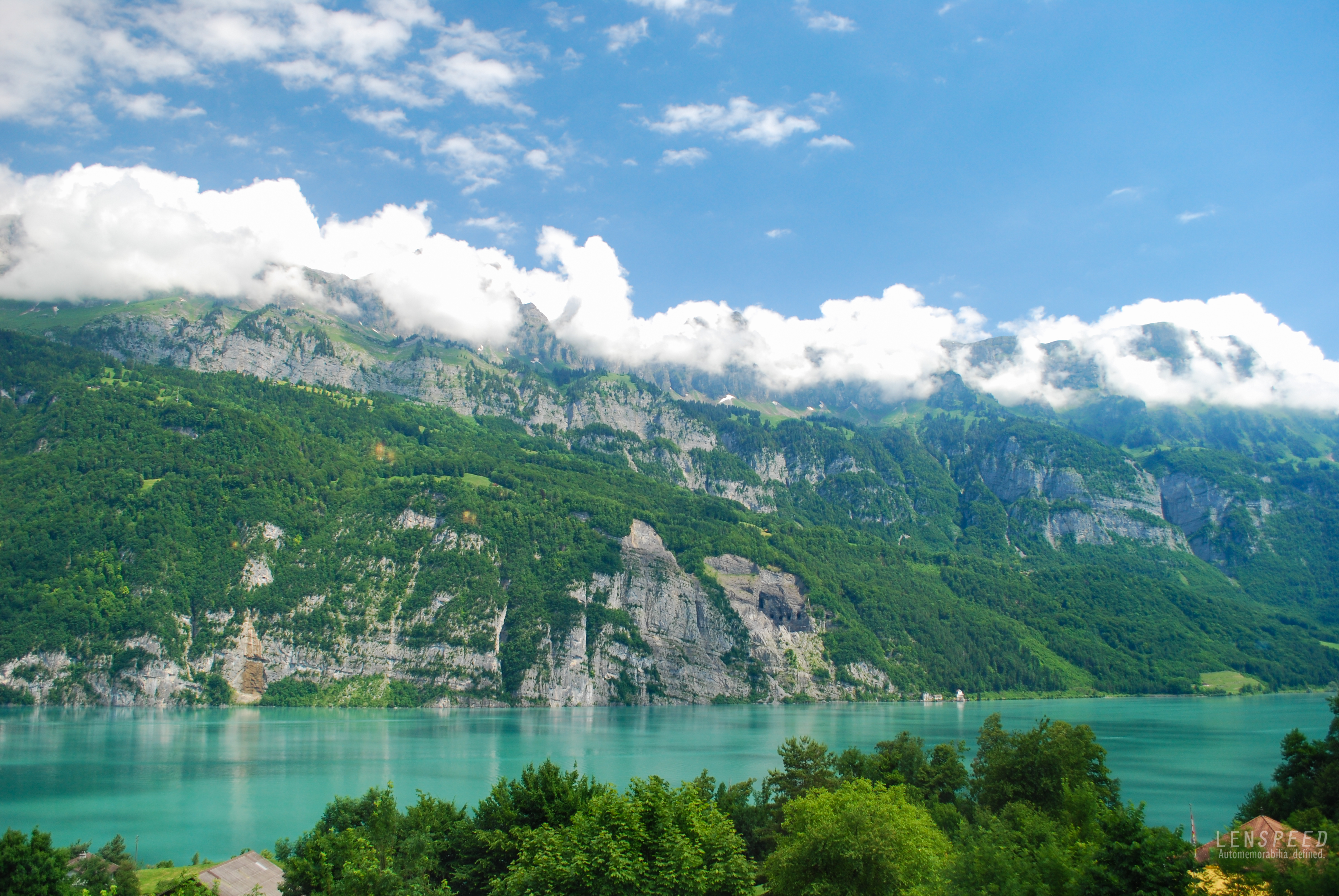
Our final jaunt south brought us slightly warmer temperatures and more balmy environments, which meant that everything looked greener and more lively. Take this turquoise lake for example, while we were en-route to Stelvio.

DSC_0070

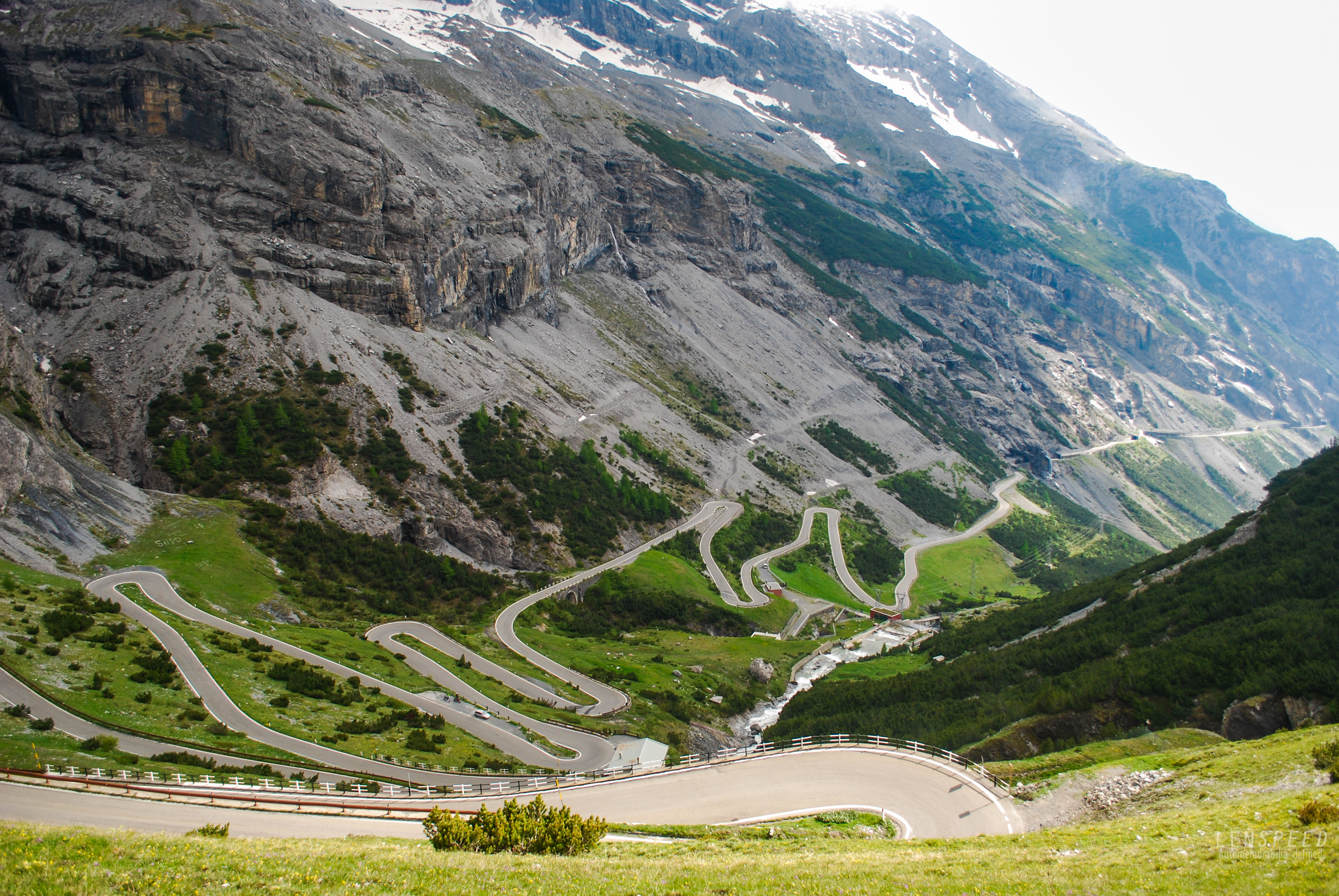
As we entered Italy to climb Stelvio from the south side, it dawned upon us very quickly that the Stelvio is extremely popular with tourists and enthusiasts. As such, the narrow roads going up were simply no fun. There are many moments where we had to reverse to let a whole convoy of cars through, while managing deep drops to the ravine at the sides. Luckily, we managed to take a breather here before proceeding further up.

DSC_0135

This is just a teaser for what’s to come. Consider it mini-Stelvio…

DSC_0173

The real deal is a lot steeper, with a rougher edge to it that hints at its poorly-maintained nature. I cannot deny that it is a terrifying climb up this road, as it is so narrow and you literally only go upwards, only taking breathers while you slow down at the hairpins. I don’t think you can go very fast here or even try to hoon. The Stelvio then, is quite overrated in Lenspeed’s opinion, but it still must be experienced because it is very humbling.

And that’s all of it. It really happened after all. I don’t think much else can top this for some time yet.


Leave a comment

By The Lenspeed Team

DSC_4675-2

We get down and dirty with two diesel engines for two very different purposes

Diesel vehicles might only form a minority of passenger cars on local roads these days, but we are slowly noticing an upward trend, with local dealers hyping up the benefits of diesel haulers over the past year.

Actually, diesel ownership makes plenty of sense, both from a driver and financial standpoint. Your perception about diesels might be swarmed with encounters in taxis with “clattery” motors, leaving you concerned with excessive noise levels from the engine bay. But modern interpretations of diesel engines have improved through the years in terms of refinement, to an extent that they feel as quiet and polished as the petrol equivalent. They are extremely frugal and can easily cover longer distances than petrol variants, too. And they deliver plenty of low-end torque, which makes city driving a cinch.

Both cars featured here are unconventional (and probably unloved?) variants of their respective models, largely due to the fact both feature diesel motors beneath the hood. But more drive time revealed plenty of advantages unique to each car. The Volkswagen Touran TDI and Volkswagen Touareg R-Line 3.0 TDI are clear-cut examples of utilising diesel motors to complement VW’s efficient motoring philosophy. They might have paper numbers wedged on both ends of the spectrum, but scrutinise the spec sheet and you get the drift. One has a motor that can very well redefine efficient motoring, while the other makes you wonder if there is actually logic behind big petrol SUVs.

The Touran TDI’s 105bhp 1.6-litre unit churns out 250Nm right from the get-go. We are talking about torque levels more than a 2.0-litre Honda-fettled K20A engine. But that’s only the bonus, really. What it can do is achieve well over 1000km per tank of fuel. (1300km to be exact, proven by VW’s drive to Ipoh and back without the help of petrol stations) When put to the test on a quiet Saturday morning, we covered 25 kilometres per litre – a figure only petrol owners can dream about.

While it can probably go about its business an entire month without hitting the pumps, this ridiculous efficiency does not come at the expense of performance, too. Admittedly, off-the-line sprints can be rather lethargic, which is no surprise for a car engineered to be smooth and well-sorted. But ride it on its wave of torque during in-gear acceleration and it covers ground at a decent pace. That’s petrol performance for more than twice the range. Efficient motoring for the people indeed…

The next car might not be entirely frugal but it makes use of the strength of its heartbeat to slingshot its way through almost any surface without much fuss. Think 550Nm handled by four wheels. The Touareg R-Line 3.0 TDI runs about its errands like a behemoth on steroids, and that is largely due to the fact that most of the torque is served under 2000rpm. Instead of piling on the revs, keep it within the narrow power band under 3000rpm and the tall, hulking SUV can plough through nip-and-tuck roads (and even humps) faster than most cars on the road. It lacks the top end envy of high-revving petrol units, but we reserve the beauty of these motors for smaller, sportier cars. Our three-day test drive over 500km of tarmac (and 500m of grass) yielded 9.4km/l, and we consider this mightily impressive for an engine needing to lug two tons of heft (and one horizontally-endowed driver). V8 turbo petrol SUVs might be able to keep up in the lower regions of the rev range, but their thirst for fuel is something we could not swallow.

Both cars represent the beauty of diesel engines. For whatever reason that might steer you away from diesel car ownership, give them a chance, take the plunge, and you will be rewarded with less holes in your pocket in the long run.

DSC_4647-2

DSC_4682-2

DSC_4685-2

DSC_4687-2

DSC_4690-2

Leave a comment

By The Lenspeed Team

Mercedes-AMG GT

All we can see now are interior photos, but we already have a foretaste that the quality of materials is going to be a step-up from the SLS AMG, going by the swathes of leather lining the cabin and delicious chrome detailing. It’s a strong momentum that Mercedes has been building since the new W222 S-Class, followed by the stunning new C-Class interior.

However, we can also be certain that the GT (whatever happened to the SLS name?) will no longer have the naturally aspirated V8 that we all love. We hope that while the inevitable turbocharged engine takes its place, it can be made up for by a quicker shifting gearbox, which has always been an Achilles’ heel of the SLS.

The GT will be the second car developed fully independently by Mercedes-AMG, the first being the SLS AMG. Watch for it this autumn!


Leave a comment

By Gerald Yuen

FD2R Update pic-2-2

It has been quite a while since I last posted updates on the FD2R. That could work both ways… either that I’m not learning anything new from the car, or I’m busy wringing every drop of performance out of the K20A.

But it would be ridiculous to harp on the former, because the manner in which it delivers driving pleasure on an emotional level the past two years still engages me as a driver. We’ve made a couple of tweaks along the way. Most obvious change would be to swap the stock suspension for a set of aftermarket coilovers from APi Racing (tuned to the softest setting). I was against this idea initially, but it would be utterly selfish for me to make my family withstand a harsh ride during dinner outings. And my dad uses the car 80% of the time for work, so that works out to be a no-brainer.

The softer ride gives it more fluidity when darting through bumps and cambers, and I could keep it on the boil more regularly without the fear of the rear hopping wide, and this translates to more traction as the dampers labour to gather more grip. Initial turn in does not feel as sharp as before, with the front leaning more towards understeer on part throttle. But once you give it more angle, the stiff rear (although less jarring than the OEM setup) can still hold ground effectively.

It wasn’t easy switching from proven OEM setup to one that has yet to demonstrate its worth. But to be honest, I’m very satisfied with this swap. The OEM suspension is way too stiff on our pockmarked tarmac (the rear dampers are 300% stiffer than the regular FD2). Now, there’s more reason to utilise the K20A’s top end rush without the fear of losing traction over irregularities.

Leave a comment

By Gerald Yuen

Go with the flow pic

It’s human nature to crave for the best possible version of any product they desire. Take timepieces for example. The more we get hooked onto the dark depths of the horological world, there is a tendency for us to desire more complicated “movements”, as simple automatic “ETA” complications won’t make the cut for us anymore.

The same concept applies to cars. More exposure to performance-oriented vehicles will raise the bar on our level of satisfaction. But do big numbers on paper directly translate to driving fun? Yes, driving cars with oversized motors beneath the hood will make us feel invincible, but we’d rather substitute this temporary boost of adrenaline with a continuous stream of what we call “flow”… and we assure you that it can be more fun than just driving flat out for short spurts.

So what is flow? We have to admit that this article from Pistonheads set us thinking: http://www.pistonheads.com/news/24980.htm. Simply put, flow is the ability to wring maximum potential out from a car without having to back off excessively, even when dealing with nip and tuck roads. For a vehicle to achieve ample flow, two conditions have to be met.

Firstly, the chassis has to work seamlessly with the suspension to neutralise irregularities. This might sound simple, but we’ve been in many cars that might be fast on paper but struggle to hold ground with less powerful cars, primarily due to the vital lack of understanding between suspension, chassis and tarmac. This leads us on to the second point. Optimal flow can be attained with a “less is more” approach. By operating a car with less horsepower, you are more likely to keep revs nearer to its boiling point, and that maximises the potential of both the powertrain and drivetrain most of the time.

Let’s compare a 122bhp Mk6 Volkswagen Golf, with a 200bhp Mk5 Volkswagen Golf GTI. There will definitely be occasions where we can fully utilise all 200bhp from the GTI, and it will probably reach destination Z much faster than the 122bhp Golf on the same stretch of roads. But this immeasurable sensation of flow can be lacking in the GTI – and this is where the 122bhp variant will triumph. It soaks up bumps efficiently due to the 16” rubbers that look like donuts, its chassis less rigid but well sorted to tackle regular B Roads confidently, and the engine is not overly powerful so that you can keep it on the boil most of the time. The GTI is definitely fast, but the Mk6 Golf is certainly fun.

Even if your pockets run deep enough to buy higher end variants, you might want to reconsider what makes driving fun first, before splashing the cash on your purchase. And if you are working on a tight budget, you can either rob a bank, or go with the flow.

Leave a comment

By James Wong

1538855_10151823910226485_196078532_n

Following the end of World War II, West Germany underwent an incredible economic expansion that brought it to the top leagues of industrialised countries. Unlike the United States which pursued a consumption-based growth model, Germany was always building, creating, inventing, and then exporting this great work to the world. Its automotive industry was no exception – previous relics of war, like the Volkswagen Beetle, went on to find massive commercial success worldwide.

Mercedes-Benz by then already had a rock-solid reputation, and looking back at the long lineage of the S-Class you will find the W108, although it was not officially called the Sonderklasse until much later.

W108s sold in good numbers in Singapore, although from what insiders can punt most of them were the later model 280S. Lenspeed had the immense privilege of driving the W108 recently in one of its earliest launch specifications, the 250S. This came with a 2.5-litre straight-six M108 engine with twin zenith carburettors (what fuel injection?), developing a leisurely 130bhp and a century acceleration performance of about 14 seconds. All this is purely academic, of course, because as I was about to find out, on-road performance is vastly different from what you read on the spec sheet.

1520735_10151823910571485_1272186020_n

When the W108 first approached the small lay-by where I waited, my ears immediately caught the exhaust note of something old – not old in the sense of being broken, but chugging along with character, panache and attitude. I’m not sure if the later fuel-injected 250SE would sound any different, but this one definitely evoked an atmosphere that brought me back to at least 30 years ago, in a good way.

Parking up, what was immediately apparent is the length of the car. Even by modern standards the W108 had a wheelbase and body of an elegant cruise liner, one which surely drew many respectful glances on the road especially at a time in Singapore where most people were still riding around in rickshaws, bicycles and motorbikes.

Even so, the friendly ride height hinted that it was supremely easy to get in and out of the car, as well as to look out of. That, perhaps, could explain why the side rear view mirrors were almost apologetic compared to the size of the rest of the car. They simply weren’t needed. “The beauty of the car is that you can just swing your head back if you’re reversing, and you can see everything,” says the owner of the car who demonstrated it expertly when manoeuvring in the lay-by.

1551753_10151823910176485_145984621_n

I could well have forgotten to mention how beautiful this car is. Although much have been written about the elegance of classic Mercedes-Benz cars, nothing could prepare you when you first set your eyes upon one cruising down the road. The lines are so correct, free of safety and pedestrian regulations, free of the economics of mass production (which, to be fair, kept these companies viable and making good money). It is simply a stunner, especially with the white-walled rims that are blissfully small in size, just 14-inches, which hint at a serene ride inside.

1544339_10151823910666485_65810175_n

I was fully satisfied at my little encounter with the W108, but it was an offer I couldn’t refuse when the owner said “Go on, have a go.” I said yes without thinking too much into it, but my mind wandered to managing the car’s length and lack of modern aids which make driving so easy nowadays. However with the owner beside me I could manoeuvre the car at ease, as he always chipped “Go ahead, make the turn. I know this car very well.” Reassuring indeed, especially when I didn’t want to lay even a tiny mark to symbolise my priceless opportunity to drive this beauty.

photo-11

The massive diameter of the steering wheel greets me as I landed on the traditionally bouncy Mercedes seats. Exquisitely detailed with thin chrome metal and literally a ‘cooking hob’ design, the steering wheel dominated the throne from which you can easily look over to the beautiful gauges. Although borne from an era where night interior lighting wasn’t a huge priority, the controls were easy enough to operate once found, without having to fumble through dozens of buttons like you do in modern cars. Curiously, the speedometer read in MPH, which reminded me a little of my ex-cars in England.

Laid over with MB Tex, the seats feel very new and robust, signalling they could probably last for many more decades to come.  Best of all, the cabin is so airy that rear passengers feel like they are sitting in a living room of sorts, with none of the stand-offish atmosphere between front and rear rows like you get in cars nowadays with their huge front seats. And it really is true – visibility is all-round excellent and you can drive naturally without your side mirrors. Best thing about older cars, I think.

1499464_10151823912346485_1604883230_n

Setting off, what is really impressive is the responsive of the gearbox, which can shame some of the 5-speed gearboxes you find in modern MBs like the W212 four-cylinder models before they got the 7-speeder. Equally astounding is the eagerness of the engine to haul, which it does with enthusiasm and good nature, not feeling strained in the least and lending the car a laid-back persona which then extends to the driver’s temperament. Sure, you will not be going fast as 40MPH already feels plenty fast, but that is quite the point – sit back, relax and enjoy your journey in class.

Through junctions the car turns with surprising body control, demonstrating that as early as the 1960s Mercedes has already got their damping spot on between a mix of comfort and stability. Surely the 14-inch rims helped as their thickly-profiled tyres soaked up many of the bumps along the ravaged Bukit Timah Road. Braking was a big surprise too. Equipped with all-round disc brakes with modern stainless steel brake hoses, brake feel was decidedly confidence-inspiring and strong – a laughable contrast to the wet tissue brakes in my Mk2 Golf GTI…

1484101_10151823910546485_418671215_n

Returning back to the lay-by, I was equally enamoured as I was warmed by the W108. I won’t deny that I love the Mercedes-Benz brand. The three-pointed star has been a significant part of my life as I spent a great deal of time in the W126, W140 and W220. What’s heartening to know is that there is a definite thread running through all of them, and that is the stalwart S-Class feeling that you simply don’t get riding in a BMW 7-Series or Audi A8. In the W108, I discovered where it came from and as I’ve learnt, good provenance is telling.

Is this a perfect steer? Considering that classic cars in Singapore attract only 10% of COE and that they are relatively more affordable nowadays, I’d love to have a W108 in my garage. Actually, I’d definitely have a classic Mercedes in mine at some point in my life, whether it is the W108 or something else. You don’t need a fast car to enjoy motoring. You just need a car that does what it is supposed to do well. And the W108, well, it is a classic Lenspeed machine.

Leave a comment

By The Lenspeed Team

VW Das Welt Auto-0004

Volkswagen Singapore has formally opened Das WeltAuto, its used car division wholly-owned and operated by the brand principal. Like its Alexandra and MacPherson dealerships in Singapore, Volkswagen operates as both dealer and brand principal in Singapore – the only setup of its kind in the world.

This comes very timely as the used car market in Singapore remains buoyant as new car sales continue to be sluggish. The used car transaction volume has ballooned from a low of 20,809 cars in 2006 to 63,005 cars in 2013. In the first 3 months of this year alone, 511 Volkswagen cars have changed hands in the used car market, compared to 508 new Volkswagen cars sold within the same period. This makes Volkswagen the 9th-most traded brand in Singapore, and it comes without a doubt that Das WeltAuto will want to capitalise on this.

To make buying a used Volkswagen an easier decision for prospects, Das WeltAuto has pulled out all of the stops to ensure a wholesome purchasing experience. Its new showroom at 1 Chang Charn Road, OC Building has a built-in floor area of 7,225 sq ft and will be able to house up to 30 cars at any one time.

What will set Volkswagen cars sold by Das WeltAuto apart from others in the market is its Certicate of Quality, which guarantees both mileage and service history. Furthermore, all used Volkswagen cars sold by Das WeltAuto are under four years old and have covered less than 90,000 km. They go through a stringent 115- point check and come with a minimum 12-month warranty. Servicing, grooming and touch-ups (if necessary) are all done before a car is finally approved for sale.

Head to Das WeltAuto’s official website to browse the latest cars they have for sale: http://www.dasweltauto.com.sg

Leave a comment

By James Wong

Aimed for a lofty 400km figure on the trip computer for my full tank of fuel last week – and it did it! Well, almost, but it could most certainly have made the last kilometre and then some more. I’m not sure if it’s the Malaysian fuel or my more frugal driving these days, but it’s certainly good to know that a 320 bhp car can still return almost 400 km from a 50+L tank. Let’s see where the benchmark shifts again next…

Leave a comment

By James Wong

DSC_0040

Some things in life don’t need any explanation. They are, quite often, usually great things. For instance, a dog can be nothing else but a dog. It will walk on fours, occasionally on twos if it is hungry, and it will lick you until you are drenched. Its existence, quite simply, cannot be disputed. And therefore, its greatness derives from its seeming ownership of the entire known intellect of the term ‘dog’.

Much like a dog, there is also a sports car. There are many types of sports cars, but what is one that defines the genre, which require no explanation when you see one? Whether you spot a prancing horse on the bonnet or hear it from a mile away, you know instantly – a Ferrari is the sports car. What it is definitely can’t be disputed. Which is important these days when you can call a Porsche an SUV and an Aston Martin a four-door saloon.

So when I took the Ferrari 458 for a couple of days, I knew I finally understood what it meant to drive A Sports Car.

DSC_0027

From 4.5-litres, the 458 generates about 560hp and 540Nm of torque. That horsepower figure is staggering, but the torque even more so, especially when there is no forced induction involved. And remember, this is an entry-level mid-engined Ferrari, the cheapest you can buy. Although we are quite sure in Ferrari-speak, entry-level doesn’t mean the same as what we think.

If you think about those numbers, they are really quite scary. Pretty unruly, don’t you think, if they are all going to the rear wheels only? But the 458 has defied logic and made a car that can make all that power and torque manageable, and even exploitable.

Fire up the ignition and you know you are in for a treat. The engine idles savagely and betrays more vibration than you’d be comfortable with, the latter of which seeming to seep away once warmth has enveloped the internals. At this point I should probably explain about the 458’s interior: it is unconventional in almost every conceivable way. I needed to watch a YouTube video of a chap walking around the car and showing me where all the buttons were before I could even figure out how to move off from the parking lot.

DSC_0011

For instance, reverse gear is in the form of a button in the centre console. Turn signals are buttons on the steering wheel, at the 9 and 3 o’clock. The armrests on the sides are where you’d pull a lever to open the doors, while the power window switches are located in the centre console, again. The radio, satnav and media can only be controlled by the driver (for right-hand drive models, at least), so the passenger just sits and screams while you drive. Basically, everything is where you aren’t really used to finding them. The tremendous thing is, you will get used to all of it in 10 minutes. No, really. It’s that intuitive.

However, there are foibles in the interior. The knees hit the bottom of the steering wheel, even though I’ve adjusted the wheel to its highest setting and the seats to the lowest. The brake pedal is also placed too closely to the throttle pedal, so it’s uncomfortably easy to be braking and yet accelerating at the same time. Otherwise, the seating position is near perfect and visibility excellent – I think this is one of the easiest supercars to drive. The thin B- and C-pillars help.

DSC_0069

Setting off, if you’re feeling particularly attention-seeking, Race mode is the one you want. It lets the exhaust flaps open earlier, so you get a loud blare of V8 just below 3,000rpm. However, the car is slightly irritated if it revs beyond that when it is cold, so maybe Sport mode would do just fine first. Sport should be renamed Normal because it feels like a Normal mode in any other car – shuffling of gears to the highest possible for fuel efficiency and generally being inoffensive. But then, there is no Normal in the 458. The next ‘step’ below Sport is Wet, which give the electronics full reign to nanny the car. It’s as if the Ferrari engineers knew having a Normal mode just wouldn’t cut it. Just as well, then, because the tractability of the engine at low revolutions is plainly staggering. It maintains rapid progress despite staying in the lower end of the tachometer, making the car feel lightly turbocharged. Maybe it’s the low weight of the car, or low-inertia internals. But whatever it is, it is brilliant.

If the daily tractability of the engine is impressive, you may think that Ferrari traded its traditionally ballistic top-end for it. But yet again, the 458 defies logic here. Up to its redline of 9,500rpm, the engine revs as quickly as your heartbeat tries to catch on. But while the engine is already a winner in its own right, the terrific 7-speed dual-clutch gearbox sets the car apart. All the power in the world cannot beat a well-sorted combination marrying engine and gearbox to create a stupendous drivetrain. In this car, the responses of the gearbox, from the tap of the paddle shift to the actual shift, are synaptic. It is so quick that the engine almost struggles to catch up. It is hard to imagine, but it is real.

The gearbox is at its best at higher revs though. Below 4,000rpm, understandably, it does not blip the throttle, although it will happily be efficient for you and increase the fuel range of the car mercifully. There is absolutely no complaint there – this is probably the best dual-clutch gearbox I have ever tried.

DSC_0009

Because the engine and gearbox responds so quickly, many of the driver’s faults are masked and quickly whisked away. If you are late to downshift into a corner, the gearbox will get to the gear you need even in the tightest of situations. If you thought you should have been in a lower gear upon exit, the engine’s breadth of torque ensures that this small mistake never upsets you.

Consequently, getting the tail to wiggle out is also easy. The throttle pedal is quite sensitive, so any input should be tempered with caution, at least for the first few attempts at driving the 458. Although, if the car does go sideways, it is supremely controllable, as I found out while getting around a deserted road. Staying in Race mode will allow a measure of ESP to keep stupidity from killing you (or crashing a beautiful car), so you do get adjustability with a safety net.

When you’ve had your fun and just want to cruise home, the 458 obliges. The suspension has a ‘bumpy road’ mode that smoothens the imperfections on the road, and in my opinion is the best setting for Singaporean roads. Shame then that you always have to switch it on whenever you start the car again. The gearbox’s auto mode on the 458 is also great for wafting, although it’s best to leave it to yourself if you want to have a full-on experience driving the 458. The fuel economy varies wildly depending on your right foot, but the range does increase encouragingly if you go easy on the throttle.

DSC_0031

The interior is also a great place to be while you’re pootling. The leather feels high quality, the design futuristic (mind you, the car is now almost 5 years old!) and the vastness of space commendable. You get great headroom and legroom, and passengers have been very impressed by the car’s friendliness to carrying people (it’s time to glare at a Lamborghini). However, even though the car is only a year old, rattles and creaks have started to develop. Nothing major, but I can’t help but wonder how symphonic the interior will be with age.

I haven’t even talked about the design, but you know what I’ll say. I’ll only add that my favourite line is the one that sweeps from the glasshouse into the engine bay, ending at the rear spoiler in elegance. It draws depth to the design, creating all sorts of lighting delights that will draw your eyes to examine its beauty. Every single aspect of this car has been thought through thoroughly, that much is certain.

DSC_0032

The common thought that stayed with me throughout the few days is this: is this the perfect sports car? There is a whole lot that is illogical about this car, but therein lies its brilliance – it defies convention, not to merely mock it, but to show that it is possible to have everything with no compromise. Barring the unknowns of long-term ownership and the proposition of actually maintaining a Ferrari, this is without a doubt in the running for perfection. Never has irrationality been so good.

Leave a comment